Djelloul Chetouane to Africa News: “We are aware of the danger of incitement campaigns in the Sahel”
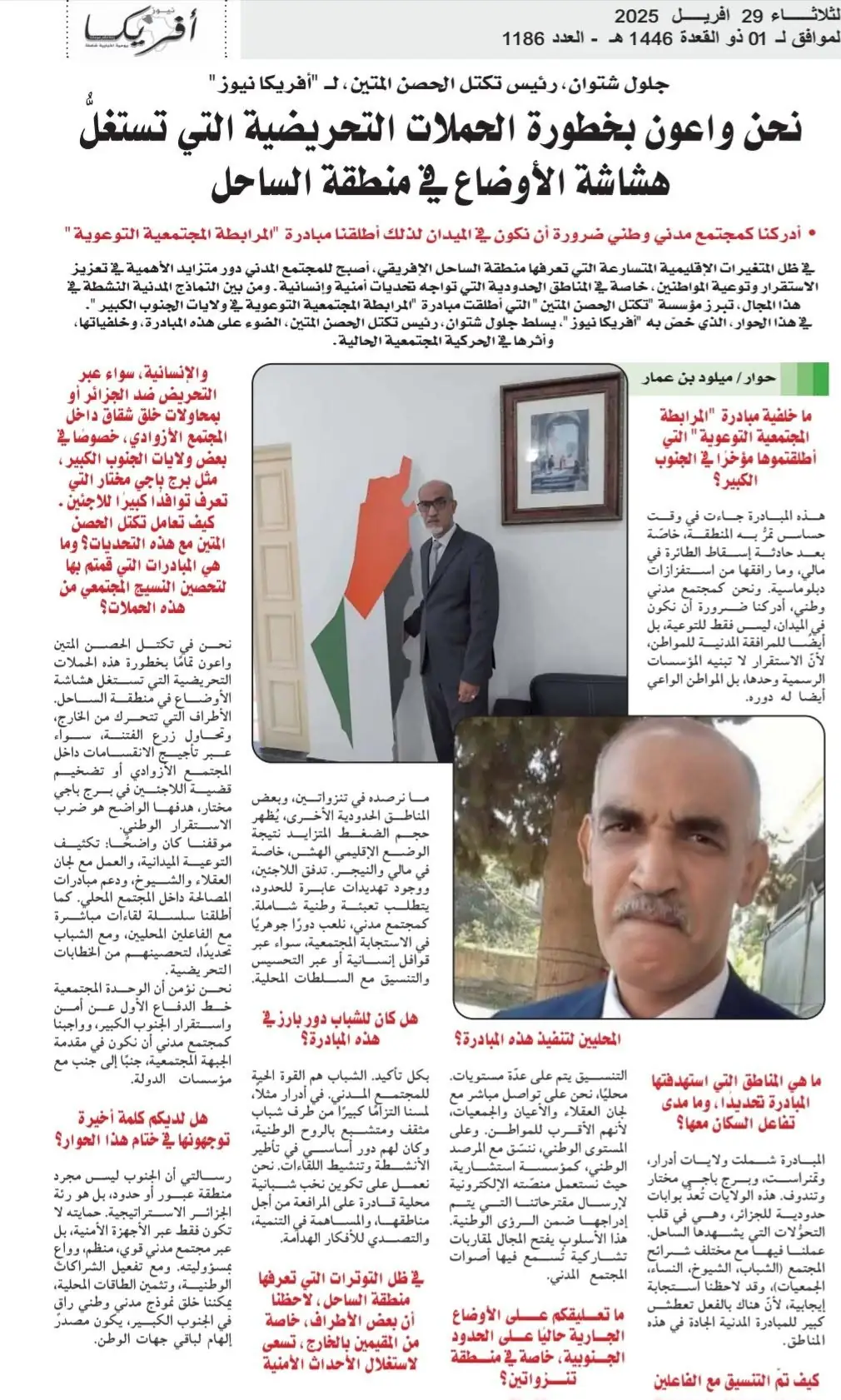
We are proud to publish today an in-depth interview with Mr Djelloul Chetouane, president of the Hisn Al-Mateen Bloc, in the Africa News daily. It is a wide-ranging conversation on current issues in the Sahel and the Greater South, highlighting civil society’s leading role in strengthening national stability.
We thank everyone who contributed to this piece, and affirm that the Institution will continue its mission with commitment and responsibility.
The interview:
Amid rapid regional changes in the African Sahel, civil society has an increasingly important role in strengthening stability and raising citizens’ awareness, especially in border areas facing security and humanitarian challenges. One active civic actor in this field is the “Hisn Al-Mateen Bloc” Institution, which launched the “community awareness outreach” initiative in the wilayas of the Greater South. We spoke to its president, Mr Djelloul Chetouane.
Q: What is the background to the “community awareness outreach” initiative you recently launched in the Greater South?
A: It came at a sensitive time for the region, particularly after the downing of the drone in Mali and the diplomatic provocations that followed. As national civil society, we realised we had to be on the ground, not only to raise awareness but also to accompany citizens, because stability is not built by official institutions alone but also by citizens aware of their role.
Q: Which areas did the initiative target, and how did residents respond?
A: It covered the wilayas of Adrar, Tamanrasset, Bordj Badji Mokhtar and Tindouf — Algeria’s border gateways, at the heart of the changes in the Sahel. We worked with all sections of society — young people, elders, women and associations — and saw a positive response, because there is a real thirst for serious civic initiatives there.
Q: How was the work coordinated with local actors?
A: At several levels. Locally, we are in direct contact with committees of elders, notables and associations, who are closest to citizens. Nationally, we coordinate with the National Observatory, a consultative body, using its online platform to submit proposals that feed into national thinking. This opens the way to participatory approaches in which civil society’s voice is heard.
Q: What is your view of the current situation on the southern borders, especially in Tinzaouatine?
A: What we see in Tinzaouatine and other border areas shows the mounting pressure caused by the fragile regional situation, particularly in Mali and Niger. The influx of refugees and cross-border threats require a comprehensive national mobilisation. As civil society, we play a vital role in the community response, through humanitarian convoys as well as awareness work and coordination with local authorities.
Q: Did young people play a prominent role in the initiative?
A: Absolutely. Young people are the lifeblood of civil society. In Adrar, for example, we saw strong commitment from educated young people imbued with national spirit, who played a key role in organising activities and leading meetings. We are working to develop local youth elites able to advocate for their regions, contribute to development and counter destructive ideas.
Q: Despite the Bloc’s high profile, some claim it is a political party, especially after it backed independent lists in the last elections. How do you respond?
A: We work within a purely civic identity; rejecting partisanship does not mean withdrawing from national political action — quite the opposite. We believe civil society can be a vital bridge between citizens and institutions, and between political and social elites. Our support for some independent lists came from this standpoint: backing clean national talent with a vision, without ties to party projects. As for the “Social Cohesion” initiative, it was our forward-looking reading of the need for national consensus, and it brought together major forces such as the FLN, the El Bina movement and TAJ, as well as national and community figures. The leaderships of those parties received us officially, which was seen as a qualitative shift in relations between civil society and the political class.
Q: Amid tensions in the Sahel, some parties, particularly abroad, are trying to exploit security and humanitarian events, by inciting against Algeria or trying to divide Azawadi society, especially in Greater South wilayas such as Bordj Badji Mokhtar, which is receiving many refugees. How has the Bloc dealt with these challenges?
A: We at the Hisn Al-Mateen Bloc are fully aware of the danger of incitement campaigns exploiting the fragile situation in the Sahel. Those acting from abroad to sow discord — by fuelling divisions within Azawadi society or inflating the refugee issue in Bordj Badji Mokhtar — clearly aim to undermine national stability. Our position has been clear: step up awareness work on the ground, work with committees of elders and sheikhs, and support reconciliation initiatives within local communities. We also launched a series of direct meetings with local actors, and with young people in particular, to protect them from inflammatory rhetoric. Social unity is the first line of defence for the security and stability of the Greater South, and our duty as civil society is to be at the forefront, side by side with State institutions.
Q: A final word?
A: My message is that the South is not just a transit zone or a border; it is Algeria’s strategic lung. Protecting it is not only a matter for the security services but also for a strong, organised civil society aware of its responsibilities. By activating national partnerships and valuing local talent, we can build an exemplary national civic model in the Greater South that inspires the rest of the country.
One Homeland, One Nation, One History, One Destiny
Photo album
Related
 MediaOn France's Radio Gazelle, Widad Hamza briefs the Algerian diaspora on inheritance and legal rights
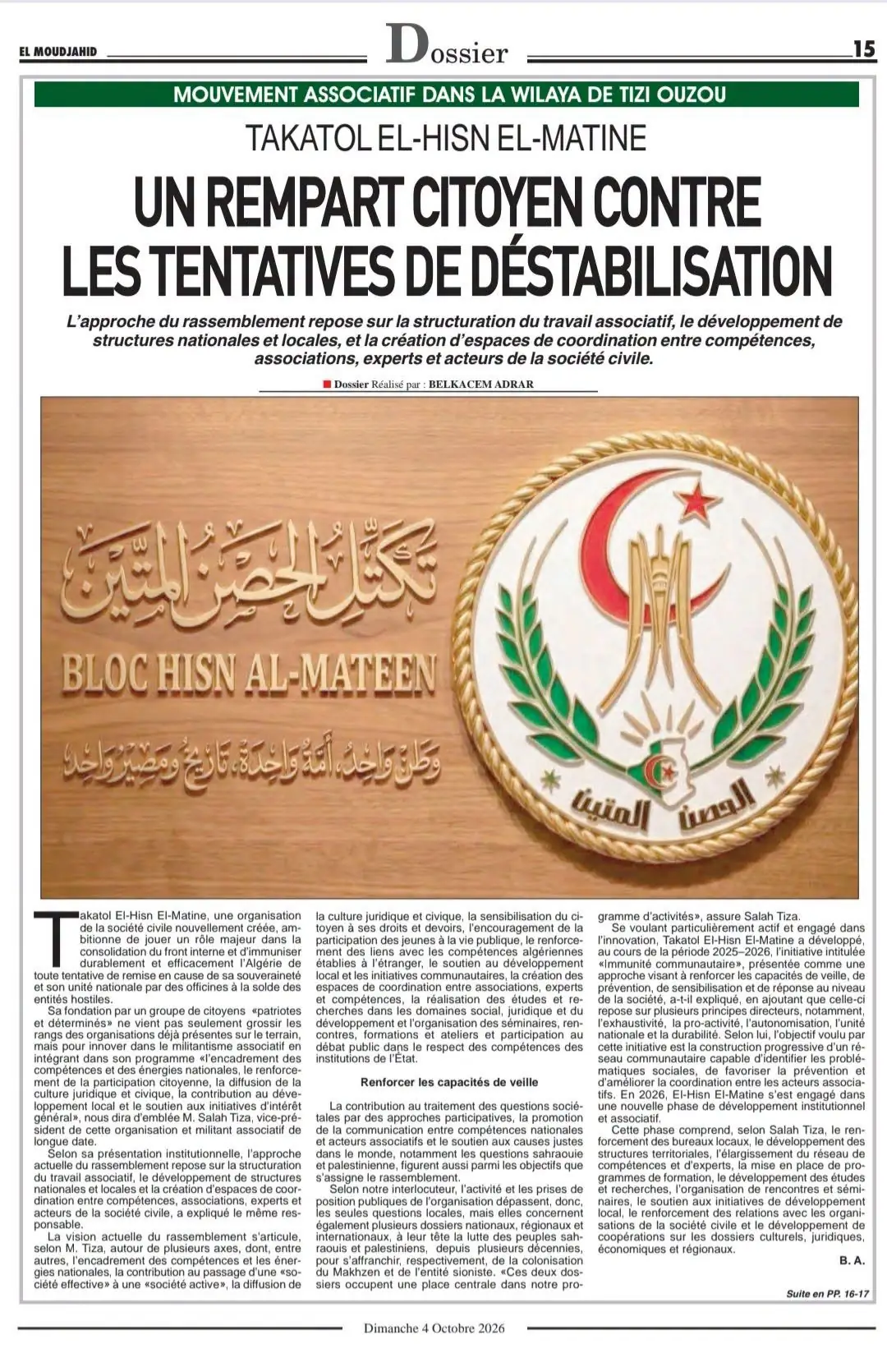 MediaEl Moudjahid profiles the Bloc as “a citizen bulwark against attempts at destabilisation”
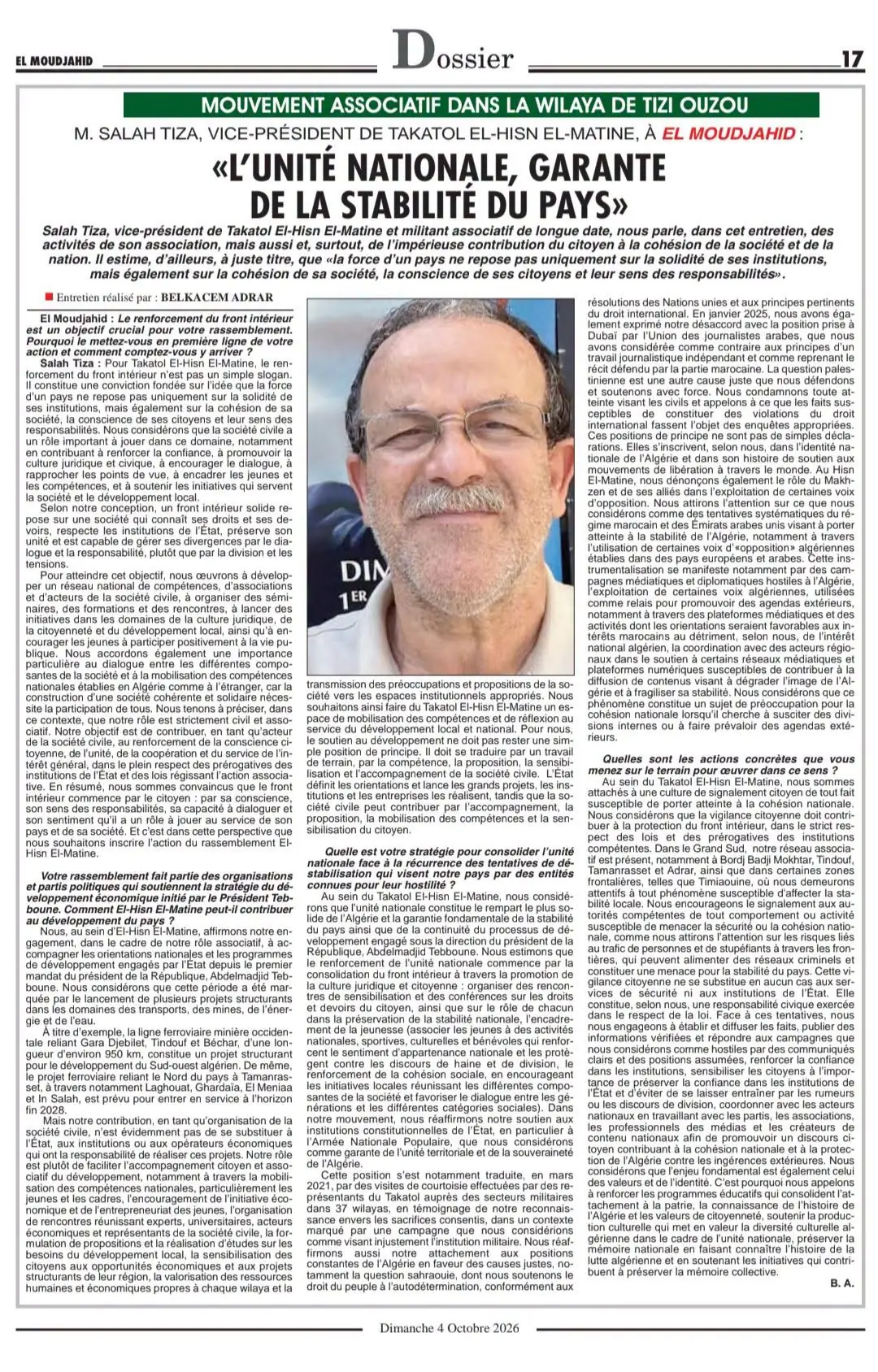 MediaBloc vice-president Salah Tiza to El Moudjahid: national unity guarantees the country's stability